Context
Small and medium businesses are where AI hasn't reached. Tech startups have their own engineers. Enterprises have the budgets for big firms. The middle is where the gap between what's possible and what's deployed is widest - and where the work is most concrete.
Kairos is the practice I make available to selected businesses in that middle. Restaurants, catering operations, retail. Two-to-three-partner businesses where the founders run everything, the workflows are paper or spreadsheet or a CRM if they're lucky, and "AI" has been a buzzword they've watched from the outside without a clear path in.
I started Kairos because I'd already built AI infrastructure for myself - Digby, Trading Digby, the whole personal stack. The same patterns that worked at the personal level mapped surprisingly well to the small-business level. The business owner is operating like a person, not like an organization. Their workflows look like personal workflows scaled up. The same architectural moves apply.
The pitch isn't I'll teach you about AI. The pitch is I'll audit how you actually work, design where AI fits, and build the system that integrates with your existing tools. End-to-end, including implementation. The deliverable is a working system, not a slide deck.
What shipped
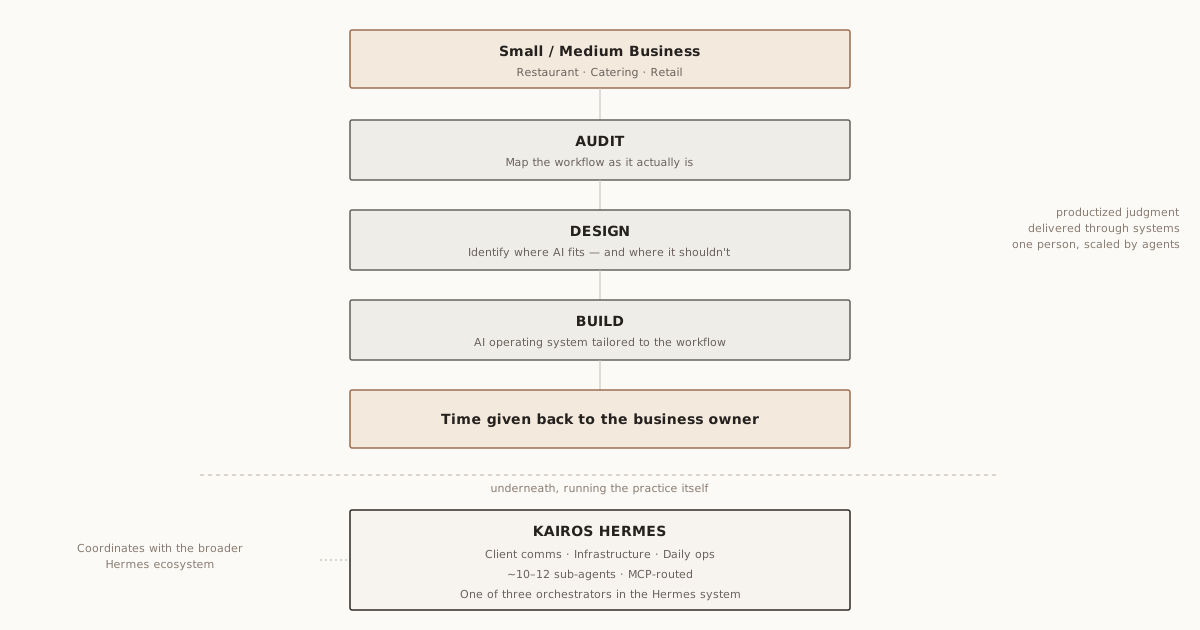
The practice has a recurring shape. A client engagement is three phases.
Audit. I sit with the business and map how they actually work. Not how they think they work - how they actually work, including the parts that are slow, the parts that are duplicated across people, the parts that take up evening hours because the daytime is too busy. Most of the value of Kairos lives in this phase. Building AI on top of a misunderstood workflow produces tools that don't get used. Audits are the bottleneck and they're irreducibly mine.
Design. Once the workflow is mapped, the question is where AI fits. Not everywhere - most workflows have parts that should stay manual because the human judgment in them is the value. The design is about identifying the specific points where AI removes friction or scales attention, and the points where it shouldn't be used. This is judgment work, the same kind that the senior team at Atlas exercises, applied to a different context.
Build. Then I build it. Often the deliverable is something close to an AI operating system for the client's daily workflows - social media management across Instagram, Facebook, X; client communication; scheduling; routine reporting; whatever cluster of repetitive work was eating their evenings. The system runs in the background, integrates with the tools they already use, and gives them their time back. Each one is tailored - there's no template, because no two small businesses run the same way.
The infrastructure that makes this scalable is the unfair advantage. Kairos Digby - one of the three orchestrators in my Digby system - runs the practice operationally. The agent handles client communication, infrastructure design, and the routine ops of a consulting business. I'm the design and judgment layer; Kairos Digby and its sub-agents handle execution and the operational layer. The consulting practice operates at a scale that would normally require a small team. The team is agents.
That's the recursion that makes Kairos credible. I'm not offering AI to small businesses while running my own practice with sticky notes. I'm available for selected SMB projects because I've already built the system that runs my own.
What landed
Real businesses with working systems. Restaurants with AI-driven social presence across multiple platforms. Catering operations where the back-office is now an agent stack. Retail with inventory and customer touchpoints connected through AI tooling.
What landed in every case isn't a feature list - it's time given back to the business owner. The work most of these clients were doing in the evenings, after the actual business of the day, gets compressed into hours that the system handles in the background. Their nights become theirs again. That's the only outcome that matters.
The clients stay. The systems integrate into the daily rhythm. The audits I did six months ago still describe how those businesses run today, with the AI layer doing the work it was designed to do.
What I learned
The first lesson is that the audit is the work. Building the AI is the straightforward part once you know what to build. In the SMB context, the hard part isn't technical - it's understanding a business well enough to know where AI fits and where it doesn't. I spend more time listening than coding, and the engagements that go best are the ones where I spent the longest in the audit phase before touching a line of code.
The second lesson is one I'd undo if I started over. I trusted the AI infrastructure to do work that needed more human oversight upstream. The agents are powerful and they execute well, but the judgment about what to deploy and where has to be mine. The system can run a consulting practice operationally; it can't substitute for the human in the design and audit phases. Kairos Digby makes me faster, not less essential.
The third lesson is about the business itself. I expected that small businesses would be hard to convince on AI - that the founders would be skeptical, that the integration would meet resistance, that change management would be the bottleneck. The opposite has been true. Small business owners want their evenings back more than anyone. When the deliverable is time, the decision cycle gets much shorter. The hard part isn't convincing them; it's making sure what I deliver actually does what I promised.
The hardest lesson is the one about what consulting actually is at this scale. It's not a service business in the traditional sense. It's productized judgment delivered through systems. The product is the system. The judgment is what makes the system fit. Both have to be there, and the agent infrastructure is what makes both scalable for one person.
Next: focusing on leveraging trained LLMs for each client. Same architecture as the model I'm building for myself - fine-tuned for the client's domain, voice, and workflows. The agents stop being generic Claude/GPT calls and start being the client's. Productized custom intelligence at small-business scale.